Self-Test
Bring Technology to Your life
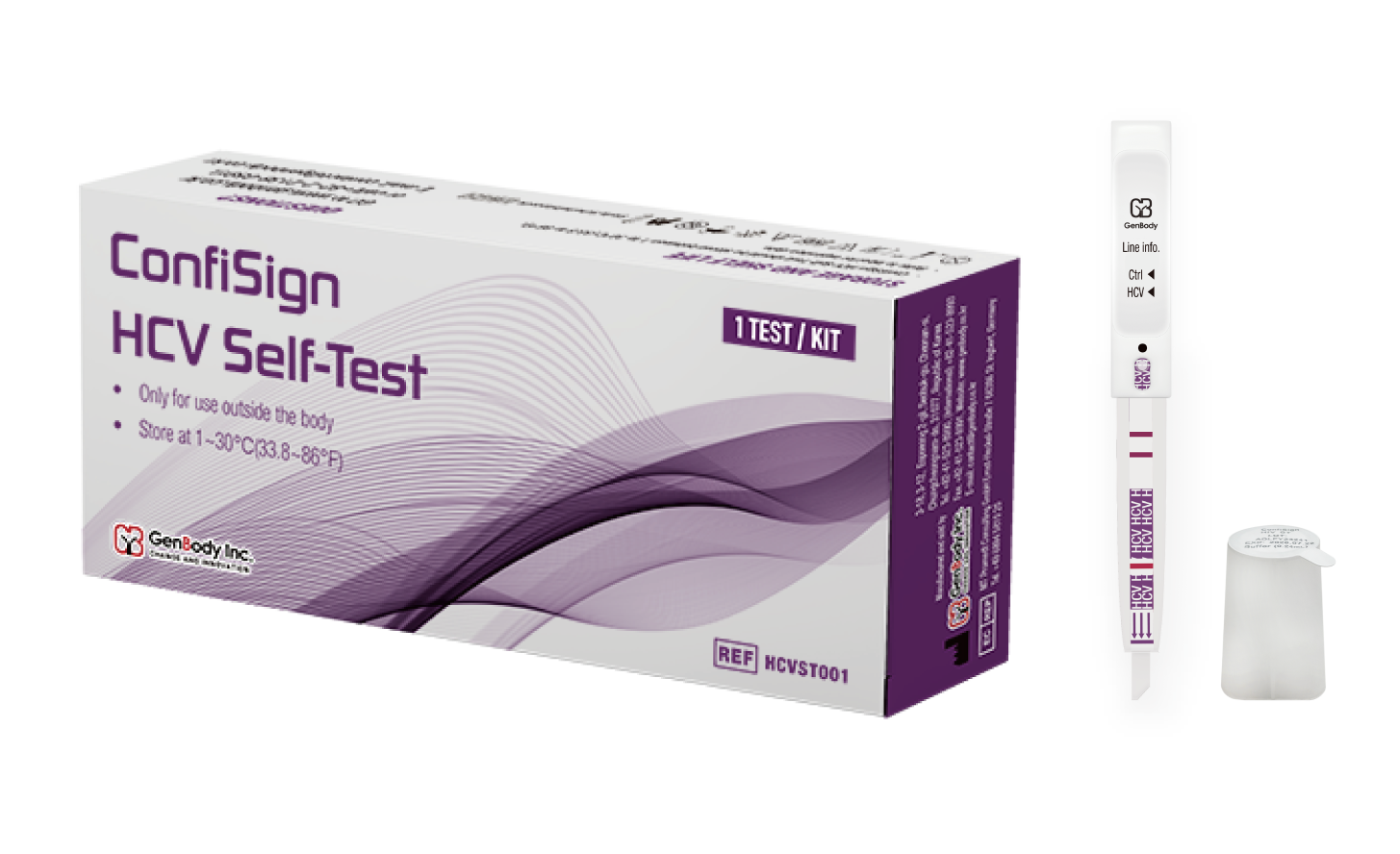
ConfiSign HCV Self-Test
A qualitative, single-use in vitro diagnostic self-test for the detection of Hepatitis C Virus (HCV) antibodies in capillary (fingerstick) whole blood. Designed for untrained lay users in a private setting.
Key Features
- 1 Test / Kit
- For Self-Testing
- Anti-HCV
- Result in 15–25 min
- Store 1–30°C
Product Specification
ConfiSign HCV Self-Test is a qualitative, single-use, manual in vitro diagnostic self-test for the detection of antibodies to the Hepatitis C Virus (HCV) in capillary (fingerstick) whole blood. It is intended for use by untrained lay users in a private setting as an aid in the diagnosis of Hepatitis C infection.
A rapid, qualitative immunochromatographic assay. Recombinant HCV antigens (HCV chimeric) are conjugated to colloidal gold, and the nitrocellulose membrane is immobilized with anti-human IgG at the test line. When the specimen is introduced, the conjugate and specimen contact the anti-human IgG on the membrane; if the specimen contains antibodies to HCV, a red line appears at the HCV test line within 15 minutes. A control line (Ctrl) confirms the test ran correctly.
Provided: test device, assay solution, sterile safety lancet, alcohol pad, desiccant, plastic bag (for disposal), and Instructions for Use.
Required but not provided: bandage, watch or timer, tissue.
Required but not provided: bandage, watch or timer, tissue.
Store the kit as indicated on the package (1–30°C). Bring all components to room temperature (15–30°C) for 15–30 minutes before testing. Do not use an expired device; refer to the packaging for the expiration date.
Read the result 15–25 minutes after pushing the device down; the control line appears within 15 minutes.
- Reactive (Positive): two red lines (HCV line + Control) — possible HCV infection; visit a healthcare facility for confirmatory testing.
- Non-reactive (Negative): one red line at Control only.
- Invalid: no Control line — repeat with a new kit.
Performance characteristics are described in the Instructions for Use.
For in vitro diagnostic use outside the body only; single-use disposable device — do not reuse. The test only indicates the presence of antibodies to HCV and may not detect infection acquired within the last 3 months (window period) or when the antibody titer is below the detection limit; a negative result does not completely rule out HCV infection. A reactive result must be confirmed by a healthcare professional. Treat the used kit and specimen as biohazardous and dispose of in accordance with local regulations.
Frequently Asked Questions
General Self-Testing
HCV self-testing allows a person to collect their own fingerstick blood sample, perform the test, and read the result themselves in a private setting. It is a simple screening approach that can help individuals decide whether further testing or medical advice may be needed.
ConfiSign HCV Self-Test is an immunochromatographic assay-based, single-use, in vitro diagnostic self-test for the rapid and qualitative detection of antibodies to Hepatitis C Virus (HCV) in capillary fingerstick whole blood.
The test detects antibodies to Hepatitis C Virus (HCV). The test includes an HCV test line and a control line.
The test is intended for home use by untrained individuals as an aid in the detection of HCV infection. It is suitable for users of all ages; however, individuals under 14 years of age should be tested with a guardian.
Testing can help individuals seek medical advice, confirmatory testing, counselling, and appropriate care when needed. Follow-up testing is important because HCV infection may require further clinical evaluation to determine whether current infection is present.
Yes. The test can be performed in a private setting. Your result does not need to be shared unless you choose to do so or unless further care, confirmatory testing, or support is required.
When used correctly and according to the Instructions for Use, the test is a reliable screening test. However, a reactive result is not a final diagnosis and must be confirmed by a healthcare professional using appropriate confirmatory testing.
Preparing the Kit
Before starting, carefully read the Instructions for Use. The test involves preparing the kit at room temperature, collecting a fingerstick blood sample, filling the sampling tip with sufficient blood, inserting the device into the assay solution, pushing the device fully down, waiting for the required time, and reading the result at the specified time.
The kit includes an accessories pouch, test device pouch, plastic bag for disposal, assay solution, sterile safety lancet, alcohol pad, desiccant, test device, and Instructions for Use.
A bandage, a watch or timer, and tissue are required but not provided in the kit.
Store the kit between 1 and 30°C (33.8 to 86°F). Refer to the packaging for the expiration date. Before testing, allow the components used in the test to remain at room temperature for 15-30 minutes.
No. Before starting the test, the handle and transparent cassette should be separated and positioned in the “CORRECT” position as shown in the Instructions for Use. If the handle appears to be in the “INCORRECT” position, pull the handle at the top of the device to adjust it to the “CORRECT” position before testing.
No. Do not use the test if the assay solution has been spilled. The correct volume of assay solution is required for the test to work properly. Use a new test kit.
Do not use the test if the kit is expired, the test device pouch is damaged or already opened, any component is missing, the desiccant indicator shows an invalid condition, or the kit has not been stored as instructed. Do not use this test if you have already been diagnosed with Hepatitis C or are currently taking medication to treat it.
No. ConfiSign HCV Self-Test is a single-use disposable device. Do not reuse the test device, lancet, assay solution, or any other single-use component.
Blood Collection & Procedure
The test is generally quick and may cause only minimal discomfort. When collecting a fingerstick blood sample, you may feel a small pinch for a few seconds.
Use only capillary fingerstick whole blood. The test is designed for this sample type and should not be performed with other specimen types unless specifically supported by the Instructions for Use.
No. After pricking your finger with the lancet, wipe away the first drop of blood with tissue. Gently squeeze your finger to create a full second drop of blood, and use the second drop to fill the sampling tip.
Fill the sampling tip of the device with a sufficient blood volume as shown in the Instructions for Use. An insufficient blood volume may affect test performance or invalidate the result.
After inserting the blood-collected device into the assay solution, push the device firmly down to the bottom of the assay solution. If positioned correctly, the purple indication line should be just below the surface of the assay solution and should not be clearly visible.
No. If the device was not correctly inserted or fully pushed down, the test may not run properly. Do not rely on a result if the procedure was not performed correctly. Use a new test kit or seek assistance from a healthcare provider or approved support service.
Yes. The test is designed for home use by untrained individuals. If you would like support, you may ask a healthcare worker, counsellor, trained provider, guardian, or approved support service for guidance.
Understanding Results
Read the result between 15 and 25 minutes after pushing the device. Do not read the result before 15 minutes or after 25 minutes, as this may lead to incorrect interpretation.
A negative/non-reactive result means that only one red line appears on the control line (Ctrl), with no line on the HCV line. This means HCV antibodies were not detected by the test at the time of testing. It is recommended to retest after three months, particularly if recent exposure is possible.
A positive/reactive result means that two red lines appear: one on the HCV line and one on the control line (Ctrl). A reactive result indicates possible HCV infection. A positive result may indicate current or past HCV infection, including infection that has cleared or been treated. Confirmatory testing is required.
Even if the HCV line is faintly visible, the result should be interpreted as positive/reactive when the control line is also present. A faint line should not be ignored.
An invalid result means that the color band does not appear on the control line (Ctrl) within 15 minutes. The result cannot be interpreted. Re-test with a new ConfiSign HCV Self-Test device and a new specimen, or go to a clinic for confirmatory testing.
If your result is negative/non-reactive, continue to protect yourself and repeat testing when recommended, especially after recent exposure. If your result is positive/reactive, visit a healthcare facility, clinic, or approved testing service for confirmatory testing and further support. If your result is invalid, repeat the test with a new kit or seek assistance.
Medical Limitations & Follow-up
The test detects antibodies, which may not be detectable immediately after infection. The test may not detect HCV infections that occurred within the last 3 months. If recent exposure is suspected, repeat testing after the window period and consult a healthcare provider or approved testing service.
No. This is a screening test. A positive/reactive result must be confirmed by a healthcare professional using appropriate confirmatory testing. The test should not be used as the sole criterion for the diagnosis of HCV infection or treatment.
No. This test detects HCV antibodies only. A positive/reactive result may indicate current infection or past infection that has cleared or been treated. Additional confirmatory testing is required to determine whether current or acute HCV infection is present.
No. A negative result does not completely rule out HCV infection, particularly if exposure was recent, antibody levels are below the detection limit, the specimen was improperly collected, or the test procedure was not followed correctly.
No. Do not use this test if you have already been diagnosed with Hepatitis C or are currently taking medication to treat it. Consult a healthcare professional for appropriate follow-up and monitoring.
No. The intensity of the HCV line for a positive/reactive result does not reflect how much HCV antibody is present in the blood specimen.
Seek medical advice. A healthcare provider can recommend repeat testing, confirmatory testing, or additional testing based on your exposure history, symptoms, and local testing guidance. Coinfection with other pathogens cannot be ruled out based on this test alone.
Do not rely on the result if you are unsure that the test was performed correctly. Use a new test kit and carefully follow the Instructions for Use, or seek assistance from a healthcare provider, counsellor, trained provider, or approved support service.
Support, Safety & Disposal
Place all used components back into the plastic bag and dispose of the kit bag in a waste bin or household rubbish, or in accordance with local regulations. Blood can transmit infectious diseases; clean up spills safely.
It is normal to feel nervous before testing. Support from a healthcare provider, counsellor, trained provider, guardian, or approved support service may help you before and after testing.
Yes. Questions may be asked confidentially through approved healthcare providers, counsellors, helplines, digital support platforms, or the relevant program support channels.
Regulatory Status & References
ConfiSign Self-Test products are manufactured under an MFDS (Republic of Korea) export-only manufacturing approval. Additional international authorizations are in progress.
MFDS — Export-only
Manufacturing approval, Republic of Korea
EU Regulation 2022/1107
Referenced common specifications (in progress)
WHO TSS-1
HIV RDT for self-testing — technical specification
Customer Support
As part of our post-market surveillance commitment for self-test products, our support team is available to help with product use, results guidance, and feedback.
Mon–Fri 08:00–17:00 (KST) · For a reactive or unclear result, please consult a healthcare facility for confirmatory testing.
TEL
Call +82-41-523-8993
WA
WhatsApp +82-10-2689-4618
EMAIL
contact@genbody.co.kr