Human Products
Bring Technology to Your life
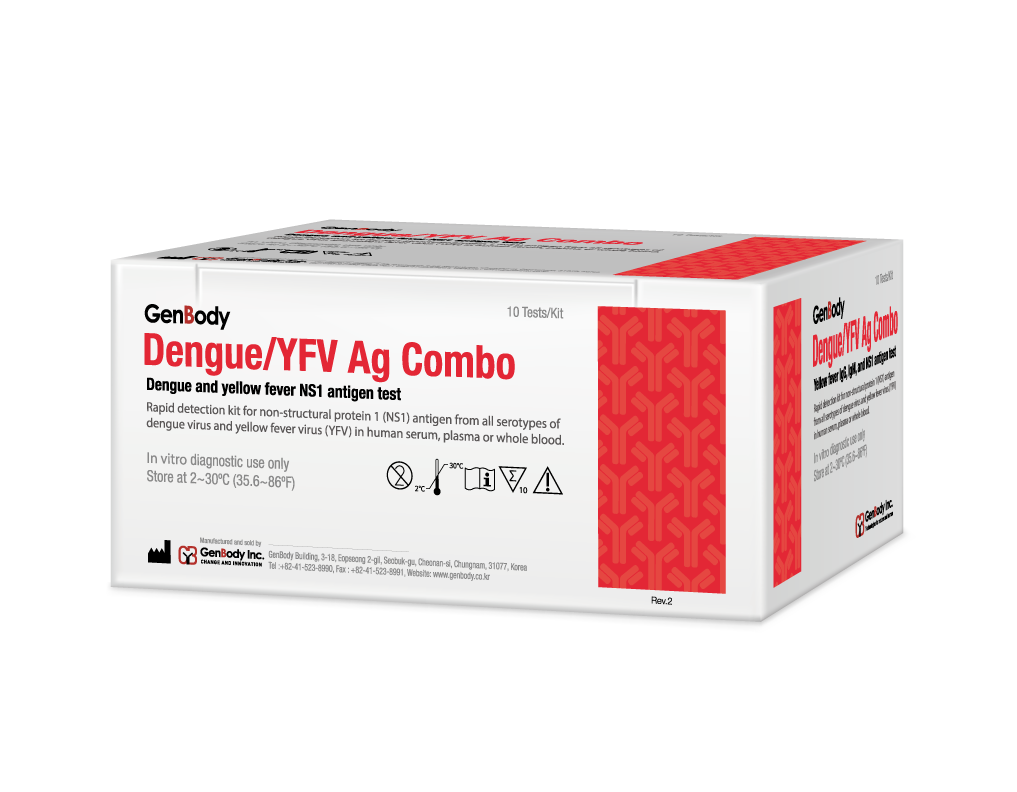
Dengue/YFV Ag Combo
Chromatographic immunoassay kit for rapid and differential detection of Dengue and Yellow fever antigen (NS1) in human specimen.
- Product features
-
- Getting results In 20 minutes
- Simple and easy to use
- Optimized for Point of Care with a small diagnostic kit
- No need to use extra reader
- High diagnostic accuracy
- Economical and capable of mass testing
Specification
Specimen Serum, Plasma, Whole blood Specimen volume Serum, Plasma 5μL, Whole blood 10μL Test time 15-20 minutes Storage temperature 2-30℃ Expiration date Refer to label for expiration date Sensitivity Dengue NS1 Ag : 93%, YFV NS1 Ag : 95% Specificity Dengue NS1 Ag : 100%, YFV NS1 Ag : 98% Dengue fever is a disease caused by the infection of the dengue virus to humans and is an acute febrile disease accompanied by high fever. Mosquitoes with the dengue virus spread during human bites. This mosquito is distributed in the tropical and subtropical regions of Asia, the South Pacific, Africa, and the Americas. It is a disease that does not exist in Korea, but recently, about 30 cases have been reported every year after visiting the epidemic area. Mosquitoes that transmit the dengue virus are mosquitoes that live around the house, usually in rainy lung tires or water puddles, and are mainly active during the day. When infected with the dengue virus, a sudden high fever occurs, and the fever lasts for three to five days, and severe headache, muscle pain, joint pain, and loss of appetite occur. In the early stages, red spots sometimes appear throughout the body. As the fever drops, skin rashes continue all over the body for 1 to 5 days. Initially, a millet-shaped rash temporarily appears on the face, neck, and chest, and then begins on the chest and torso on the 3rd to 4th day and spreads to the limbs and face.
Yellow fever is a hemorrhagic fever caused by a virus that is prevalent in Africa and South America. The virus that causes the disease is an arbovirus, which is spread by mosquitoes. Therefore, the habitat of mosquitoes that can spread this virus coincides with the major yellow fever outbreak area. It was called yellow fever because some of the patients with the disease had symptoms of turning yellow due to jaundice. Symptoms can be divided into incubation period, acute phase, and toxic phase. After the incubation period of 3-6 days, an acute phase appears. In the acute phase, symptoms such as fever, muscle pain, chills, headaches, loss of appetite, nausea, and vomiting appear. It is common for symptoms to disappear three to four days after these acute symptoms occur, but about 15% of patients will enter a toxic phase afterward. Patients with toxic phase develop fever again and rapidly develop symptoms such as jaundice, abdominal pain, and vomiting. In addition, bleeding can occur in the mouth, nose, eyes, and gastrointestinal tract because liver function is deteriorated and blood clotting factors are not properly produced in the liver. Acute renal failure may occur, and about half of patients entering a toxic phase die within 14 days.